 During the mid 1950s, a tough new breed of guitarists began to emerge from Chicago's West and South sides. These twenty-something bluesmen had all been raised in the South, and they played loud, hard, and sure-handed. Master string-shakers, they framed their cathartic tales of heartbreak and woe with unforgettable riffs and story-telling solos. Their ranks included Magic Sam, Freddie King, Buddy Guy, Joe Young, Luther Allison, Jimmy Dawkins, and first among them to score a hit, Otis Rush.
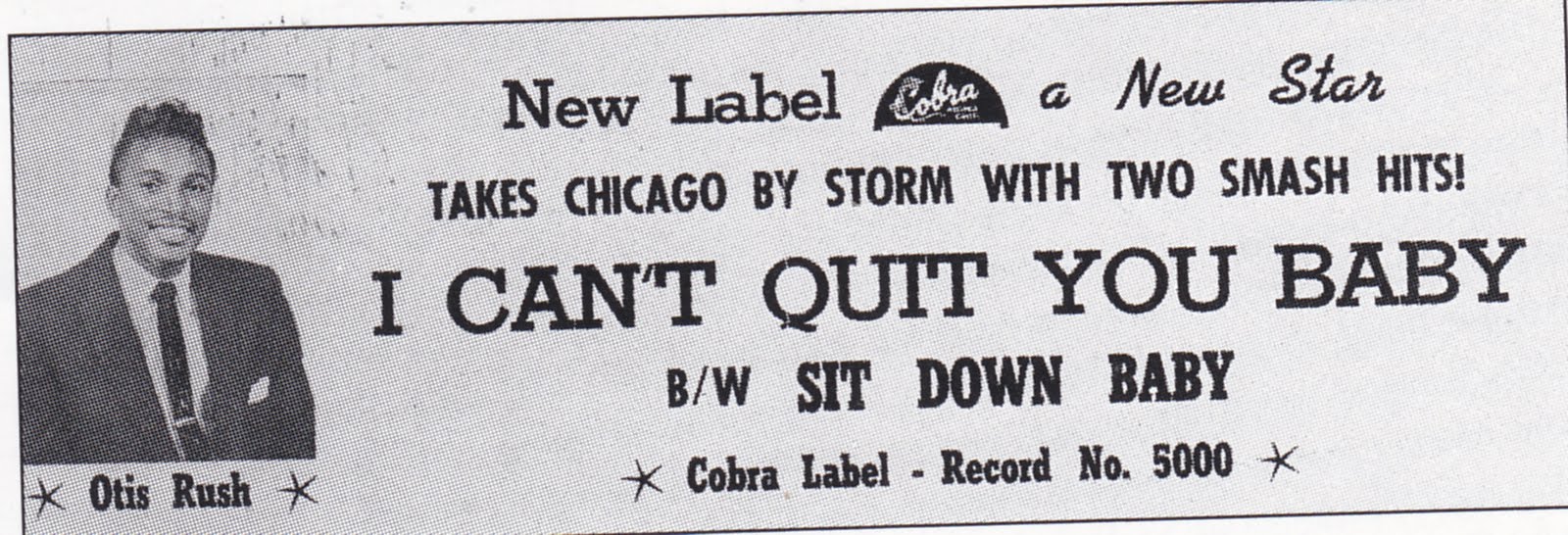
Rush's very first recording, a heartrending rewrite of Dixon's "I Can't Quit You Baby" delivered with a fever-and-chills v
 ocals, reached the Top 10 in Billboard's charts for "R&B Sellers in Stores" and "Most Played R&B in Juke Boxes." Hailed as one of Chicago's most brilliant performers, Rush was soon moving in progressive directions. His sultry moaning and groaning in Dixon's "My Love Will Never Die" foreshadowed '60s soul ballads, while his tormented, strikingly original "All Your Love (I Miss Loving)," "My Love Will Never Die," and "Double Trouble" became urban blues classics. With its visceral attack, beautiful phrasing, shimmering vibrato, and elastic bends, Otis' guitar approach was soon inspiring a generation of rock and blues guitarists – Eric Clapton, Jimmy Page, Peter Green, Magic Sam, Carlos Santana, and Stevie Ray Vaughan among them. On Rush's recommendation, Cobra recorded Magic Sam in 1957 and Buddy Guy in '58 (with Otis playing rhythm guitar on Guy's first Chicago recording).
Under Dixon's guidance, Rush signed with Chess Records and recorded another classic – "So Many Roads" – in 1960, but the association proved to be one of many unhapp

 y experiences he'd have with record labels. Later in the decade he cut records with mixed results for Duke, Vanguard, and Atlantic's Cotillion subsidiary. His brilliant 1971 album Right Place, Wrong Time lived up to its name, staying on the shelf for a half-decade. Rush confessed to being "high as a kite" from alcohol while making 1975's Cold Day in Hell
  for Delmark, and his 1978 Sonet LP, Troubles, Troubles, would be his last studio album for sixteen years. He played occasional dates and recorded live albums for Delmark, Black and Blue, Trio, and Blind Pig, but mostly stayed home drinking and "living off the land" by "hustling pool, trying to catch the lottery."
In 1994, Rush ended his studio hiatus to record Ain't Enough Comin In
 for Quicksilver Records, using the same production team and core musicians as Buddy Guy's Feels Like Rain. But unlike Guy's album, with its airwaves-approved duets and star names, Rush carried the show alone, journeying from p
 assionate pleas to gritty soul and sanctified screams. The title track was the album's sole Rush composition.
Rush says that his latest release, Any Place I'm Going
 , co-produced with his wife Masaki and Willie Mitchell for House of Blues, is "better than any stuff I've ever done, because of the sound." He recasts his old Cobra single "Keep on Loving Me Baby" with a modern sheen and delivers a taut slow blues with "Looking Back." The album's other Rush original, the title track, was co-written with Will Jennings, of Titanic and "Up Where We Belong" fame.
Through the years, Otis Rush has been characterized as a brooding, intensely guarded man who's extraordinarily reticent during interview
 s. This was not the case during the following two-and-a-half-hour conversation, which took place in Chicago on August 8, 1998, in the lobby of Rush's upscale North Shore high-rise. Perhaps Rush’s unflinching recollections of his youth provide insight into the anguish that drives so many of his classic recordings. It originally appeared as the cover story of Living Blues #142 in November 1998.
* * * *
When you were beginning to play, did you solo right away or go through learning chords first?
I learned solos right away, because I was playing more like John Lee Hooker, Muddy Waters, stuff like that. I began to practice, and I learned as I go. I'm still learning.
Did you own an acoustic guitar when you were young?
Yes, I did. I didn't own it, but my brother did. I have a brother – he can't play, but he bought a guitar. I guess that was my big break. His name was Leroy.
Was this in Philadelphia?
Yeah, Philadelphia, Mississippi.
You once described that town as being so small you could throw a baseball across it.
Yeah. You can bat a home run, and it's over! [Laughs.] It's in Shelby County. It's forty-some miles from Meridian, a hundred miles from Jackson, Mississippi. Living there was a hell of an experience for me.
Why is that?
Just the things you had to go through. This was back in the '40s and '50s.

This 1938 Mississippi Highway Map lists the population of Philadelphia as 2,560.
Was there a lot of racism?
Yeah, a lot of that too. I've had to go around the back to restaurants. When white people are having dinner, I must wait till they get through eating. After they eat, then we could eat. I'm not kidding. The rest rooms, they had signs up there – "White" and "Colored." You know I'm telling the truth. It was all over. You'd go to a restaurant, even on the highway, and it'd say, "Colored, go around the back." When we wanted some food, we can't order from the front. But I don't want to get into that. Like I say, it's been a hell of an experience.
You've said that your hard times started around the time you were five years old.
That's right. My mother didn't have a husband. There were seven of us – five boys and two girls, and she had to raise us by herself. I'm what they call a bastard. All my brothers had another father – they're half-bothers – and I have one whole sister, Odie Mae. There's also Leroy, Lorenzo, Eugene, and Wilmon. The other sister is Elizabeth. The seven of us had to support each other.
Did you ever work in a field?
Oh, yeah. Oh, yeah! From five years old. My mother and older brothers and sisters be out in the field picking cotton, pulling corn, or something. I'm lookin' at them workin', and I wanted my mother to compliment me. Every time I'd pull some cotton, I'd give it to her and let her put it in her sack – she used to drag the sacks. She said, "Boy, you're doin' great!" She kept on telling me how great I worked. I get tired and go sit in the shade, so at some point she said, "Come on, boy." I said, "What, mom?" "You pick that cotton like you been pickin'." I didn't want to pick it. She said, "You better come on, boy, I ain't gonna tell you no more." So at six, seven years old, man, I'm working my ass off. I had to pick that cotton. At nine or ten years old, my goodness, I was plowin' the mule, turning this land over with the plow. No tractor – they had 'em, but not on this farm.
The white man let us go to school when the weather was so bad out there that we can't go to work. And we'd be prayin' for bad weather all the time! [Laughs.] We would hope for a storm, so today we could go to school. I went to school, man, but not like I should have. I'd be in school, I have all these plans for today – this is my great day – and [knocks three times, then says in a loud, gruff voice] "Junior in there?" They called me Junior and Bud then. "Is he in there? Send him out here." Then he'd say, "Come on, boy. I want you to go out here and cut them bushes and do that bottom over there." I come out of that school mad, man! I felt like kickin' my own ass. But, hey, you better get up and go – don't you be seein' that damn tree with that limb hangin' out like that with them ropes around it? Shit. I come out of there – and no argument! My teacher don't argue, just, "You got to go! You got to go, Junior!"
Were you aware of lynchings?
Was I aware of them?! I knew all the time what they'll do! I'm livin' there, man! I'm livin' in Philadelphia, Mississippi.
Nowadays most people are unaware that thousands were lynched in the South before World War II.
Hey, you don't be careful, they still do that shit down there. Okay? And you don't have to go so far south to run into one of these peoples. Right here in Chicago – you understand? You could go around a block, and you'll run into one of them. What do you call it – Klu Klux Klan? They everywhere, man! Look at what they just did to this man in Texas – drag a man behind a pickup truck until he's dead. That ain't happened no ten years ago. That just recently happened. So you know I gotta be right because they still doin' it! And who knows how many peoples is under the water or under the bushes and trees and leaves. We don't know they're there, but somebody know where they're at. A lot of peoples is missing.
When is the last time you went back to Philadelphia?
I went back eight or nine years ago. I played out there in Hollandale and went to see my brother.
When you were a kid, did you ever see anyone playing a one-string or diddley-bow?
One-string guitar? No.
Did you know people who played blues music?

Not really. I used to listen to John Lee Hooker's records. He was about one of the oldest guys out there. John Lee Hooker and Charles Brown. Charles Brown played piano, and he had a great sound. And today, I can hits those notes on my guitar, and you can almost swear that it's a piano player.
Yeah, a lot of that too. I've had to go around the back to restaurants. When white people are having dinner, I must wait till they get through eating. After they eat, then we could eat. I'm not kidding. The rest rooms, they had signs up there – "White" and "Colored." You know I'm telling the truth. It was all over. You'd go to a restaurant, even on the highway, and it'd say, "Colored, go around the back." When we wanted some food, we can't order from the front. But I don't want to get into that. Like I say, it's been a hell of an experience.
You've said that your hard times started around the time you were five years old.
That's right. My mother didn't have a husband. There were seven of us – five boys and two girls, and she had to raise us by herself. I'm what they call a bastard. All my brothers had another father – they're half-bothers – and I have one whole sister, Odie Mae. There's also Leroy, Lorenzo, Eugene, and Wilmon. The other sister is Elizabeth. The seven of us had to support each other.
Did you ever work in a field?
Oh, yeah. Oh, yeah! From five years old. My mother and older brothers and sisters be out in the field picking cotton, pulling corn, or something. I'm lookin' at them workin', and I wanted my mother to compliment me. Every time I'd pull some cotton, I'd give it to her and let her put it in her sack – she used to drag the sacks. She said, "Boy, you're doin' great!" She kept on telling me how great I worked. I get tired and go sit in the shade, so at some point she said, "Come on, boy." I said, "What, mom?" "You pick that cotton like you been pickin'." I didn't want to pick it. She said, "You better come on, boy, I ain't gonna tell you no more." So at six, seven years old, man, I'm working my ass off. I had to pick that cotton. At nine or ten years old, my goodness, I was plowin' the mule, turning this land over with the plow. No tractor – they had 'em, but not on this farm.
The white man let us go to school when the weather was so bad out there that we can't go to work. And we'd be prayin' for bad weather all the time! [Laughs.] We would hope for a storm, so today we could go to school. I went to school, man, but not like I should have. I'd be in school, I have all these plans for today – this is my great day – and [knocks three times, then says in a loud, gruff voice] "Junior in there?" They called me Junior and Bud then. "Is he in there? Send him out here." Then he'd say, "Come on, boy. I want you to go out here and cut them bushes and do that bottom over there." I come out of that school mad, man! I felt like kickin' my own ass. But, hey, you better get up and go – don't you be seein' that damn tree with that limb hangin' out like that with them ropes around it? Shit. I come out of there – and no argument! My teacher don't argue, just, "You got to go! You got to go, Junior!"
Were you aware of lynchings?
Was I aware of them?! I knew all the time what they'll do! I'm livin' there, man! I'm livin' in Philadelphia, Mississippi.
Nowadays most people are unaware that thousands were lynched in the South before World War II.
Hey, you don't be careful, they still do that shit down there. Okay? And you don't have to go so far south to run into one of these peoples. Right here in Chicago – you understand? You could go around a block, and you'll run into one of them. What do you call it – Klu Klux Klan? They everywhere, man! Look at what they just did to this man in Texas – drag a man behind a pickup truck until he's dead. That ain't happened no ten years ago. That just recently happened. So you know I gotta be right because they still doin' it! And who knows how many peoples is under the water or under the bushes and trees and leaves. We don't know they're there, but somebody know where they're at. A lot of peoples is missing.
When is the last time you went back to Philadelphia?
I went back eight or nine years ago. I played out there in Hollandale and went to see my brother.
When you were a kid, did you ever see anyone playing a one-string or diddley-bow?
One-string guitar? No.
Did you know people who played blues music?

Not really. I used to listen to John Lee Hooker's records. He was about one of the oldest guys out there. John Lee Hooker and Charles Brown. Charles Brown played piano, and he had a great sound. And today, I can hits those notes on my guitar, and you can almost swear that it's a piano player.
That's spending some time with the music.
Well, I practiced. I didn't learn it overnight. Over the years I learned how to do this, but his songs always stuck in my mind – "Black Night," "Driftin' Blues." He had other tunes out there that I was crazy about. I thought he was the most fantastic singer and piano player that I ever met. I still think this today about those old sounds, them old records – you can't beat this, man! And you had piano players everywhere trying to sound like Charles Brown. I learned a lot of his stuff on my guitar, and you don't see a guitar player playin' piano on his guitar. But honest to God in heaven, I can hit it.
Did you get that from playing along to the record?
No, just listenin' and never forget them sounds. I learned a lot of stuff note-by-note. I hit this note [frets an imaginary guitar], and I says, "That don't sound right; I got to keep on practicin'." I kind of put it together at one point, and I do it onstage right now. I play a little of Kenny Burrell's stuff – "Chili Con Carne" ["Chitlins Con Carne
 "]. I do a little of Wes Montgomery [hums a riff] – that's "Bumpin' On Sunset
 ." I used to play that. George Benson, man, but he came up late from these guys.
Click on the blue links to download songs and albums.
Did you ever hear of Charlie Christian?
Yeah, yeah, yeah, yeah. He was a monster on the guitar, you understand? And Wes just captured it all. I'm lookin' at him play with his fingers. I played next door to him – Wes was in one door, and I'm in the next door. He was playin' at the Plugged Nickel down on Wells, downtown Chicago, and I'm playing at Mother's Blues. You had all kinds of musicians coming through the Plugged Nickel – Kenny Burrell, everybody.
Did you copy any blues guitar records, like "Boogie Chillun"?
John Lee Hooker, of course. I can play that. I won't say note-for-note, but I did learn "Chili Con Carne" note-for-note, and that's a lot of scratchin'. I took me a month to really work it out. I can play it today. My son Tony, who's on my new CD, we recorded this in Memphis, but we didn't put it on the record. My son play the guitar.
Did you teach him?
Some little things, I teach him. I carried him on the road with me one time in Canada, but he was a bit young, and he wasn't ready for the stage. But now he's a Chicago policeman, and the police station has got some kind of band, and they do shows. Tony's by my first marriage, and my two daughters is by Masaki. Lena's 18 years old, going on 19, Sophia's 15 going on 17. And are they bad! Ooh, my goodness. If I didn't love 'em . . . [Laughs.] I tell you what, I'd ditch 'em! But I love 'em, and, oh, man. How strong is love? Nobody knows. Because if I didn't love 'em, I don't know what I'd do. I know I wouldn't be foolin' with 'em! They wouldn't be around me if I didn't love 'em.
Are they hard-headed?
Oh, man, they got other words for it. I ain't gonna say it, because you're taping me. They nice children, but them teens, them teenagers. When I was comin' up, I don't think I was like this. I couldn't be.
Was your mother strict?
Shoot! [Laughs nervously.] I used to get my butt whooped. One time I went with my brother Eugene – he died – to a place where they gin cotton. I guess I was about eight or nine. My brother was a teenager. There was a pencil sharpener hangin' on the wall of this gin. We looked at it, and he tore it off the wall. "I'm gonna get this, Bud" – he called me Bud – "I'm gonna take this." I said, "Yeah, man, yeah!" I'm happy he took it. When we get home, my mother could see it got some splinters on it from where it tore off the wall. So she says, "Where'd you guys get this pencil trimmer at?" And I jumped up and said, "He found it, mama, I 'clare he did." We couldn't even say "swear" – hey, you say "swear," you gonna get that belt on you – so we'd say, "I declare, mama."
She says, "You sure you find this?" Now my brother said, "Yeah, mama, I found it." Again, I said, "Yeah, mama, he found it, I 'clare he did." She said to me, "Boy, come here. How come this wood and nails hangin' here? Boy, you lied to me. I'll fix you up." She didn't whip my brother, but she told me to go take my clothes off. Meantime, she was humming and braiding together three peach tree branches, just like people do hair. She said, "You lied to me. You know you took that." I said, "I didn't take it – he took it!" "But you told me you find it, didn't you?" "Yeah, but mama, what you gonna do with those branches?" She said, "I'm gonna give you the whoopin' of your life." I said, "You can't whoop me with that, you'll kill me!"
She wailed me and wailed me, and I hit the floor. I can't do nothin' but scream. I guess I'm jumpin' so fast and hard, it's hard to get hit, so she grabbed me by the legs and lift me up. She took me by my feets, held me upside down, and pounded my head on the wooden floor. [Laughs nervously.] She said, "Don't you lie to me again." I was glad when she turned me aloose. I'm tellin' you, she didn't play.
Was your mother churchified?
Yeah, yeah, until she got that belt. I got these whoopings like this, and ooh, I was careful about what went down from then on. She'd cut you. That old peach tree switch, it'd wrap around you. I got scars on me, and I'm not telling you all of it.
When I was a teenager, I wet the bed, and my mother tell me, "Every time you wet the bed, I'm gonna whoop your ass." So I'd get up in the morning knowing that automatically I'm gonna get a whoopin'. Sometimes I wet the bed two or three times a night. I slept with my brother, and he'd tell on me sometime. Sometimes I'd get up during the night and find the sheet and be dryin' the bed, but them pee circles tell the truth – it's there. Oh, man, I peed in the bed 365 days out of the year. She eventually took me to the doctor, and the doctor said, "Don't whoop the boy. His kidneys is bad." He gave me medicine, but it still didn't help me. I had to grow out of that.
Were you ever inclined to be violent toward others?
I suppose so. It made me angry. I can't help but to say you're right, because I begin to get angry. I get in a few fights, stuff like this. Later on, some of the musicians, something ain't right – I got in fights with musicians on intermissions.
After you moved out on your own, were you close to your mom?
I kind of kept my distance, but I love her so much. I'm glad she whooped my butt. She learnt me a lot. After she whooped me, I had respect for other peoples, most of all her. Like I say, she had seven children, and she wasn't about to let us rule her. She was disciplined, and boy, she whoop your butt.
Did your mother have any problems with your playing blues music?
Well, see, that's some of the reason I play. She used to go to town on a Saturday night, and every time she'd take me to a little cafe and feed me a hamburger and a pop – RC Double Cola. All these pins and needles would hit me in the head when I drank the pop, because I didn't know how to belch. They had a jukebox at that little cafe where I'd get my hamburger, and that's where I'd listen to Charles Brown and John Lee Hooker. Sometimes I'd buy my own bag of precooked hot dogs and go to the movies and watch Roy Rogers and Gene Autry.
Where did you learn about Eddy Arnold and the Blue Grass Boys?
Down there at the same jukebox. And it wasn't all jukebox, it was radio from Nashville, Tennessee – WLAC. Yeah! You could hear that station, man, no matter where you go. We didn't have no TV – wasn't no TV at that time. I grew up in the country on a farm.
Did you have electricity at home?
Later in my age, when I became teenage, we had electric. Other than that, it was a kerosene lamp. We didn't know nothin' about no electric.
What kind of church did you attend?
Baptist, up in the hills in the woods. That's where my church was.
Did you sing in church?
I sing, but to myself. That's when everybody was singing – the choir was singing, my mother was singing in the church. She'd sing and get happy and shout. Just like when preachers is preachin', she'd look like somebody was killin' her. She just went out of her mind and shout, I guess, from the hurt inside about life. And I know that we was botherin' her, but she had us under control because my dad was never around.
Are you the only professional musician in your family?
Yes. That's from watching my mother when we went to town and I get that hamburger. She went and bought one of them big, old wide records, a 78 by Tommy McClarence [McClennan], and Lightnin' Hop
 kins. She would say, "Listen to that fool play!" I heard every breath she breathed, you understand? My ears was inside of that record, listening. And John Lee Hooker – she kept buying up those records. There was a lady called Bessie Smith. And Memphis Minnie – hey, man, she was something else on the guitar. She was more like a modern singer and guitar player in those days. Louis Jordan.
We had a wind-up record player, and we'd wind that up until the spring get so tight, then we put that record on. It was spinnin' – sound good, you know? It had a little dog and said "RCA Victor." Anyway, we had the Soul Stirrers, Sam Cooke, the Five Blind Boys, just different records. We had these big records, and it was just like a nightclub to me. We wind that thing up and I'd listen to it, and I'd learn to find notes on my guitar. But they had a guy named Vaughan Adam. He had been to the Army, and he came back out of the war. He was slick on the guitar. He could play all them pretty chords. We live on the same farm. We was livin' on Otis Lewis' farm. I never will forget him. There was a bunch of houses on his plantation, and everybody live close together near the front office – bang, bang, bang – and as far as you could see was acres of farm fields.
At what point did you say, "I gotta get out of here, and maybe music's my way out"?
I ain't never thought I'm gonna be playing no music. When I came to Chicago, I was farmin'. I had my own little place by then – I had left home. I had my own little farm, five acres, and I was stayin' on a white man's farm. And I had the most prettiest field – it was just like a movie, and people stopped to take pictures of it. It was so rich, and I did it! They'd park their trucks, and every day, they lined up out there, looking at my work. I grew corn – got fourteen wagon loads of corn – and I did about five bales of cotton, so I got a bale to the acre. I didn't have no stock.
Did you grow greens and other vegetables?
Yeah, we grew that, but there was so much of that around, you don't even think about that. I grew this on this white man's farm. I was sharecroppin'. Whatever I make on this farm, I have to give him half of it. God's truth. He put all the money up for my fertilizer and stuff. You got to have poison to keep the bugs and boll weevils off of the cotton. I worked by moonlight at night. I got a scar on my stomach right now from turning this thing that spread the poison – I turn that knob so many times, it rubbed it sore. I put it on when the dew falls. The poison looks like flour from the kitchen when you bake biscuits. It just land on that dew, and that's what made my cotton so special. I'd work from sunup to sundown. Then I'd go home, eat, get a little rest, and then about ten, eleven o'clock, get up out of the bed, go out there and work by that moonlight until about two or three in the morning. Then I'd go back and get a little rest, then get up and go back out there.
That's a hard way to live.
I did it. Even when it was too bad weather for me to work in this field, he had a truck to haul logs from the woods and take them to town to the sawmills. That's where you get your lumber from to make houses. I knew how to load this truck with all them big logs – it had them big hooks – and if I wasn't workin' in the field, I'd take that. I'd get paid a little bit for that. I worked, I worked, and then at the end of the year, my crops was so rich.
Now, harvest time, he asked me in the field one day, "Otis, I want you to tell me something." I said, "Sure, if I can." He says, "What's six times six?" I said, "Thirty-six." He said, "Damn!" You know, I'm not supposed to know these things. I just said it at the time, but I really didn't know what it were. I just guessed thirty-six. I went back and started counting my fingers and said, "Damn! I was right!" So he didn't cheat me too much. That's what he was after. See, if I'd have said forty-six or twenty-six, he'd tear me up. Nobody had to tell me – he asked me that question to see if I could count. He gave me a pretty fair shake, okay? He still took lots – as a matter of fact, all my corn. But he gave me cash money for my cotton. I started counting, laying on the bed – I said, "Damn! I've got to go."
My sister had said she had met T-Bone Walker up here in Chicago, people like these. Muddy Waters. They had jobs up here, you know. I said, "Maybe I go up there and get me a job!" So I came to Chicago, thinkin' I might be able to get a job and stay awhile and work, and then go back. So I went, and eventually I did find a job. I stayed here two weeks with my sister, and she took me by to see Muddy Waters.
How old were you at the time?
I don't know. I was in my teens.
Where did you see Muddy?
Muddy was at Zanzibar. That's about 1400 West Roosevelt. That's where I saw my first musician alive onstage. It was Muddy Waters, Jimmy Rogers, Little Walter, L.C. McKinley, and Junior Wells was there. As we got out of the car, I heard this music. I'm thinking it's a record, a jukebox. And when I went in there and looked up on my left, they was up there playin' that stuff, and I flipped out, man! I said, "Damn! This is for me!"

I didn't meet Muddy Waters and Junior and all of them. I froze up in the seat and just look at 'em and drink me a beer. I got up and left when I was expired by them, man. I was froze. I had already been messing around with my brother's guitar, but I didn't know anything about it. I just liked to pick it up and nurse it. I went home to my sister's, and I didn't even have a guitar in Chicago. My brother kept his when I came to visit my sister.
I had planned to go back, but after I saw Muddy and these peoples onstage, I went downtown and bought me a Kay guitar – it was so cheap. I bought a little amp, and that was so light and cheap, when I play a note, it look like the amp danced. We was livin' up on the third floor at 3101 Wentworth – that's where my sister was.
I'm up on the third floor, and all the neighbors are saying, "Oh, Lord, this boy's up there again with this noise! Lord, have mercy!" I was runnin' 'em crazy, you know what I mean? My stuff was so cheap, it really run you crazy. But I was enjoyin' the hell out of it, and I just played day and night. I'm sittin' up there at the time peoples' getting to bed. I get up early in the morning and wake 'em up, tryin' to play what I heard Muddy and them play onstage. I went out and bought his records. I used to sound just like him. I used to play all that stuff, like Little Walter, Muddy. I used to make my livin' doin' that after I got started – playin' like them.
Help support this blog and independent music journalism by making a small donation via the Paypal button at the bottom of this page.
Did you go back to Mississippi?
I stayed here. I worked hard. I went and got me a job at G.H. Hamilton Company at 47th and Racine. They had everything from a dead man casket to turnip greens. [Laughs.] That's a cold storage. They had stock-beef. They had all kinds of departments, and you'd work different places. This was while I'm up on that third floor at my sister's house, making all that noise. I had learned a few notes, and this is how it got started.
One night a guy by the name of Bob come by. He had a club at 2711 South Wentworth – Club Alibi. He says, "Who is that guy that's been making all this noise up in the window? Where is he?" You could hear him talkin' outside. "Where is that guy? Somebody tell me where that guy is. I need somebody to play for me." I'm listening too, laying back across the bed. They point at my apartment. "He's right in that window up there." He came up and knocked on the door. He says, "You the guy that make all the noise?" "Of course. I'm him." I didn't know if he liked me or hate me. Anyway, he says, "Look. I want you to do me a favor. My band didn't show up tonight. Would you come and play for me? Come on, man. Just sit up there and play. I'll give you five dollars." Shit! I grabbed my shirt, my Kay guitar, my amp that dance when I play, and went down there, and he put me onstage. I pat my feet like John Lee Hooker, both feet goin', and I did a night. I never had a band, no way, so that was easy for me.
Like I say, I had this job at this G.H. Hamilton Company. I'm a good worker out there, and these people knew it. But after I did that five-dollars-a-night job, the guy says, "Man, you did so good, come back tomorrow night." Ooh-wee! Five dollars, for my guitar? And nobody even give me a sodie pop for playin'? [Laughs heartily.] Hey, lookee here: "Five dollars?" Then after that second night he says, "Tell you what. Come back tomorrow night too." For three nights. Four nights. I said, "That's twenty dollars – for me?"
I'm up on the third floor, and all the neighbors are saying, "Oh, Lord, this boy's up there again with this noise! Lord, have mercy!" I was runnin' 'em crazy, you know what I mean? My stuff was so cheap, it really run you crazy. But I was enjoyin' the hell out of it, and I just played day and night. I'm sittin' up there at the time peoples' getting to bed. I get up early in the morning and wake 'em up, tryin' to play what I heard Muddy and them play onstage. I went out and bought his records. I used to sound just like him. I used to play all that stuff, like Little Walter, Muddy. I used to make my livin' doin' that after I got started – playin' like them.
Help support this blog and independent music journalism by making a small donation via the Paypal button at the bottom of this page.
Did you go back to Mississippi?
I stayed here. I worked hard. I went and got me a job at G.H. Hamilton Company at 47th and Racine. They had everything from a dead man casket to turnip greens. [Laughs.] That's a cold storage. They had stock-beef. They had all kinds of departments, and you'd work different places. This was while I'm up on that third floor at my sister's house, making all that noise. I had learned a few notes, and this is how it got started.
One night a guy by the name of Bob come by. He had a club at 2711 South Wentworth – Club Alibi. He says, "Who is that guy that's been making all this noise up in the window? Where is he?" You could hear him talkin' outside. "Where is that guy? Somebody tell me where that guy is. I need somebody to play for me." I'm listening too, laying back across the bed. They point at my apartment. "He's right in that window up there." He came up and knocked on the door. He says, "You the guy that make all the noise?" "Of course. I'm him." I didn't know if he liked me or hate me. Anyway, he says, "Look. I want you to do me a favor. My band didn't show up tonight. Would you come and play for me? Come on, man. Just sit up there and play. I'll give you five dollars." Shit! I grabbed my shirt, my Kay guitar, my amp that dance when I play, and went down there, and he put me onstage. I pat my feet like John Lee Hooker, both feet goin', and I did a night. I never had a band, no way, so that was easy for me.
Like I say, I had this job at this G.H. Hamilton Company. I'm a good worker out there, and these people knew it. But after I did that five-dollars-a-night job, the guy says, "Man, you did so good, come back tomorrow night." Ooh-wee! Five dollars, for my guitar? And nobody even give me a sodie pop for playin'? [Laughs heartily.] Hey, lookee here: "Five dollars?" Then after that second night he says, "Tell you what. Come back tomorrow night too." For three nights. Four nights. I said, "That's twenty dollars – for me?"
Now, I'm up all night, right, getting five dollars a night. I was making at least seventy-five to a hundred dollars a week on my job. But five dollars for my guitar? I done lost all my rest. By the time I got to work the next day, I'm out of it. My boss says, "Otis, you're sick." I said, "Ah, I'm alright." He says, "Something is wrong with you. I know you a good worker, and I never have any problem out of you. You got to be sick." He sent me to see the company doctor, so I play the game, just like I'm sick. "Well, yeah, I guess maybe something wrong with me," but I already know what's wrong with me.
Came back, I work a little better, but I get sleepy. I was drivin' a power-lift tractor-truck. I had to lift iron and stuff – tons of stuff – and load trucks with it. This man told me, "Otis, you gonna have to take some time off until you get straightened out. You sick." I went on home and said, "I ain't goin' back to that job." So my five dollars a night became ten. Ten became fifteen. Fifteen became twenty. I worked for twenty dollars a night, and I was enjoyin' it. Rent was twelve dollars a week. When I got thirty dollars a night, I said, "Damn! For my guitar?" By now I got the fever.
By the time I had quit my job, I had saved up. I had made good with my farmin' when I left from down there, and I had put all that away – I didn't waste it. When I worked at G.H . Hamilton Company, I was working there nights and some days. I worked hard, saved a little money. And I went and bought me a second-hand car off a parking lot. It was a '48 Buick Roadmaster Torpedo, and it was laying down just like a real torpedo would lay. And I said, "Damn! Look at me!" Now I can't wait to go home. I want the peoples to see me in this car. My car was dark green, almost black-lookin', and it had Cadillac hubcaps all the way 'round it. It had a big silver sun visor up in front, and then every window had its own visor. It had a radio, heater. I said, "Man! This is me?!"
I hop in the car – I'm goin' to Mississippi. I get me a map, and I mapped it out. Never before drived it, but after I got that map, I wasn't afraid. I see it, and I see how to get there. I'm drivin' and drivin'. I wanted to drive all the way without going to sleep, but I didn't know nothing about drinkin' no coffee or taking these pills to stay awake. After a while I had gotten sleepy, and I almost killed myself. It was two-lane highway, and I dozed off, went to sleep drivin'. I could hear a truck horn – [moans twice like a blowing horn]. I'm headed straight for it! I jerked my wheel to my right, and I just missed this truck head-on. My man was blowin' his horn, and he saved my life.
Sounds like you had an angel riding alongside you.
Yeah, 'cause that would have done it. I pulled off the highway and parked that car. I was kind of up in the trees now. Lay there, couldn't go to sleep now. I was so scared. But eventually I did lay there until I got me a nap. But while I was asleep, I hear this truck come by. It had such an impact – the noise, the wind – my car was shakin'. In my dream, I'm thinkin' I'm drivin' and went to sleep again, so as I wake up I was tearin' up my car inside, because I thought I was movin'. That learnt me a lesson. That told me not to be out there drivin' sleepy. Now I be drivin', I get sleepy – I pull the car over and park it. If I see somebody in the band tryin' to drive sleepy, I want to get out and whoop his ass. Right away, I want to whoop somebody's ass. I tell 'em, "Quit it. You drivin' sleepy, you can kill everybody. If you really want to kill yourself, just let us out. Then you just drive into a tree, or stick a match to you."
Did you make it down to Philadelphia?
I made it safe and was drivin' around down there. Of course, a lot of them wanted my car. A lot of these white people say, "Where you get this car from, boy?" I say, "I bought it." After they kept tryin' that, I said, "They don't want me to have this car down here." It was kind of sharp, man, and freaked off whoever had it. I said, "It's about time for me to get the hell out from down here."
I'm getting ready to leave the next day or so, because things is getting too hot for me, and I went to a big picnic out in a pasture. These white peoples was sayin', "I want to buy this car, boy," just like that. I said, "Sure! I'll sell it." I know what time it is now. I let one guy know that he could buy my car if he wanted. But all the time, I know I'm not gonna sell him my car. I'm playin' for this time, because tomorrow he won't see nothin' but my dust. And that's what he saw – nothin' but my dust.
My brother decided to come up with me and visit because he didn't have to pay. I had a car full of peoples that wanted to come up to Chicago. But we ran out of money and almost ran out of gas. Now, I'm looking at that gas tank, and it kept getting lower and lower. I'm way out there somewhere, and the hand done got way over. I know it's about to go, and I'm so worried, I don't know what to do. Again, God provide for me. There was a guy thumbin' for a ride. You don't want to pick these peoples up, but I had said, "Maybe he can give me a few dollars, and I can get some gas and go on home." Sure enough, he said, "I'll get you some gas! Just give me a ride." What a blessing! He filled my car up. "Oh, man, fill my car with gas? Ooh-wee!" You're right – that was some angels watchin' over me. I made it back, and I wasn't wantin' too much to drive anymore because I almost had that accident.
Is this when you started putting a band together?
At first, it wasn't nobody but me playin' guitar. Then I added Poor Bob, who worked with Hound Dog Taylor, so there was two of us playin' guitar. I practiced with him, and we sit and pat our feet. Then I add Paytons [Earl Payton] on the harmonica, and that sounded so good. Then I went and got T.J. [McNulty], the drummer. He worked the same job out at the G.H. Hamilton Company, but he didn't know nothin' about no drums. I taught him how to play drums, what kind of beat I wanted. What I did, I got a bucket for him, put some rubber 'cross the top of it, and let him beat the bucket while we play.
He eventually went and bought drums, and later on he got with Luther Allison. But I'm the one that put him in music. I used to carry a harmonica on the job with me, and blow that harmonica out there. That was my first instrument. See, I remember when a dime could buy you a harmonica. That's the kind of life I lived, and I used to blow pretty good, but I got interested in the guitar.
Back in the '50s, were there different blues scenes on Chicago’s West and South Sides?
It was different. It's still different now. It's just the peoples. Some of 'em got attitudes from the South Side. Some on the South Side don't want to go to the West Side. Same vice-versa.
Came back, I work a little better, but I get sleepy. I was drivin' a power-lift tractor-truck. I had to lift iron and stuff – tons of stuff – and load trucks with it. This man told me, "Otis, you gonna have to take some time off until you get straightened out. You sick." I went on home and said, "I ain't goin' back to that job." So my five dollars a night became ten. Ten became fifteen. Fifteen became twenty. I worked for twenty dollars a night, and I was enjoyin' it. Rent was twelve dollars a week. When I got thirty dollars a night, I said, "Damn! For my guitar?" By now I got the fever.
By the time I had quit my job, I had saved up. I had made good with my farmin' when I left from down there, and I had put all that away – I didn't waste it. When I worked at G.H
 . Hamilton Company, I was working there nights and some days. I worked hard, saved a little money. And I went and bought me a second-hand car off a parking lot. It was a '48 Buick Roadmaster Torpedo, and it was laying down just like a real torpedo would lay. And I said, "Damn! Look at me!" Now I can't wait to go home. I want the peoples to see me in this car. My car was dark green, almost black-lookin', and it had Cadillac hubcaps all the way 'round it. It had a big silver sun visor up in front, and then every window had its own visor. It had a radio, heater. I said, "Man! This is me?!"
I hop in the car – I'm goin' to Mississippi. I get me a map, and I mapped it out. Never before drived it, but after I got that map, I wasn't afraid. I see it, and I see how to get there. I'm drivin' and drivin'. I wanted to drive all the way without going to sleep, but I didn't know nothing about drinkin' no coffee or taking these pills to stay awake. After a while I had gotten sleepy, and I almost killed myself. It was two-lane highway, and I dozed off, went to sleep drivin'. I could hear a truck horn – [moans twice like a blowing horn]. I'm headed straight for it! I jerked my wheel to my right, and I just missed this truck head-on. My man was blowin' his horn, and he saved my life.
Sounds like you had an angel riding alongside you.
Yeah, 'cause that would have done it. I pulled off the highway and parked that car. I was kind of up in the trees now. Lay there, couldn't go to sleep now. I was so scared. But eventually I did lay there until I got me a nap. But while I was asleep, I hear this truck come by. It had such an impact – the noise, the wind – my car was shakin'. In my dream, I'm thinkin' I'm drivin' and went to sleep again, so as I wake up I was tearin' up my car inside, because I thought I was movin'. That learnt me a lesson. That told me not to be out there drivin' sleepy. Now I be drivin', I get sleepy – I pull the car over and park it. If I see somebody in the band tryin' to drive sleepy, I want to get out and whoop his ass. Right away, I want to whoop somebody's ass. I tell 'em, "Quit it. You drivin' sleepy, you can kill everybody. If you really want to kill yourself, just let us out. Then you just drive into a tree, or stick a match to you."
Did you make it down to Philadelphia?
I made it safe and was drivin' around down there. Of course, a lot of them wanted my car. A lot of these white people say, "Where you get this car from, boy?" I say, "I bought it." After they kept tryin' that, I said, "They don't want me to have this car down here." It was kind of sharp, man, and freaked off whoever had it. I said, "It's about time for me to get the hell out from down here."
I'm getting ready to leave the next day or so, because things is getting too hot for me, and I went to a big picnic out in a pasture. These white peoples was sayin', "I want to buy this car, boy," just like that. I said, "Sure! I'll sell it." I know what time it is now. I let one guy know that he could buy my car if he wanted. But all the time, I know I'm not gonna sell him my car. I'm playin' for this time, because tomorrow he won't see nothin' but my dust. And that's what he saw – nothin' but my dust.
My brother decided to come up with me and visit because he didn't have to pay. I had a car full of peoples that wanted to come up to Chicago. But we ran out of money and almost ran out of gas. Now, I'm looking at that gas tank, and it kept getting lower and lower. I'm way out there somewhere, and the hand done got way over. I know it's about to go, and I'm so worried, I don't know what to do. Again, God provide for me. There was a guy thumbin' for a ride. You don't want to pick these peoples up, but I had said, "Maybe he can give me a few dollars, and I can get some gas and go on home." Sure enough, he said, "I'll get you some gas! Just give me a ride." What a blessing! He filled my car up. "Oh, man, fill my car with gas? Ooh-wee!" You're right – that was some angels watchin' over me. I made it back, and I wasn't wantin' too much to drive anymore because I almost had that accident.
Is this when you started putting a band together?
At first, it wasn't nobody but me playin' guitar. Then I added Poor Bob, who worked with Hound Dog Taylor, so there was two of us playin' guitar. I practiced with him, and we sit and pat our feet. Then I add Paytons [Earl Payton] on the harmonica, and that sounded so good. Then I went and got T.J. [McNulty], the drummer. He worked the same job out at the G.H. Hamilton Company, but he didn't know nothin' about no drums. I taught him how to play drums, what kind of beat I wanted. What I did, I got a bucket for him, put some rubber 'cross the top of it, and let him beat the bucket while we play.
He eventually went and bought drums, and later on he got with Luther Allison. But I'm the one that put him in music. I used to carry a harmonica on the job with me, and blow that harmonica out there. That was my first instrument. See, I remember when a dime could buy you a harmonica. That's the kind of life I lived, and I used to blow pretty good, but I got interested in the guitar.
Back in the '50s, were there different blues scenes on Chicago’s West and South Sides?
It was different. It's still different now. It's just the peoples. Some of 'em got attitudes from the South Side. Some on the South Side don't want to go to the West Side. Same vice-versa.

Is it true that Muddy tended to play the South Side while Howlin' Wolf played the West Side?
No, they was playin' for Sylvios. Sylvios was West, out on Lake Street. The 708 Club was East 47th Street, real close to Cottage Grove, and that was South. I remember these addresses so well. So they playin' backwards and forwards. They play over there sometimes on the weekends, sometime over here. Just where they could get a gig at.
Were your Cobra sessions the first time you played with a decent band?
That was before the Cobra session, because me and Louie Myers and Dave Myers had start practicin' and playin', and that's when I started making fifteen dollars a night. We called ourselves the Four Aces – I named us. Junior Wells was playin' half-time with Mu ddy. Muddy had Little Walter playin' with him, but Little Walter had made "Juke," and that was a hot record. Walter went on his own.
What kind of guy was Little Walter?
Walter, they tell me, was rough.
Did you ever hear the rumor that he was murdered?
Yeah, yeah. But let me tell you about Walter. Walter was a hell of a nice guy to me. I never find no faults in him. I sit there and talk to him just like I'm talkin' to you. He talk to me, he make all kind of sense. We made sense to each other. Howlin' Wolf was the same. I heard lots of peoples talk about him, but I never had no problem. I talk to these guys and give 'em respect, and I got it in return.
Did you know another of Muddy's harmonica players, Henry Strong, who was also known as Pot?
I know Pot, and he was a hell of a damn harmonica player. Nice kid, man. Pot got killed by a knife. Juanita killed him. She would hang around the clubs where we played. You know, she hang awhile, but I'm kind of movin' out, you know what I'm sayin' [motions like he's moving away from someone, then laughs]: "I got somethin' to do. I gotta go get me a beer right here. I gotta go to a wife someplace." I been knowin' the girl for a long time, man – for years – and wouldn't of thought that she'd do something like that. Pot went out, stayed a one-night stand, and she got that switchblade and tapped him, cut him two or three times. Bang, bang, bang – it was over. She hit that wrong spot. They locked her up – she got a record, but she did that shit and got out of it.
When was the first time you saw a record with your name on it?
That was "I Can't Quit You, Baby." I got copies from the record company.
What was your reaction?
I had flipped already. When I went in the studio, I know I'm making this record, right? I don't know if I had made twenty [years old] or not. Anyway, Willie Dixon helped me on that: "I can't quit you, baby, I gotta put you down for a while. Messed up my happy home, you made me mistreat my onliest child." Believe me, I didn't have no idea what I was getting into when I record this record. But Willie had some things written I didn't like, so I changed a lot of the words. And it was a hit! It was the biggest record for me for a long time.
Did you send copies home to Mississippi?
No. I was so excited, I don't even talk to them. I don't even call them. My head was so jammed up with the music: "I'm a artist. I can play. I made a record!"
Didn't Muddy give you some advice after your first hit?
Yeah, yeah. That was at the 708 Club, parked right out front. He said, "Otis, I want to talk to you." Him a nd Jimmy Rogers and all of 'em out there, sittin' in the car, drinkin'. Well, I had my share of drinks, and he was tellin' me, "You got a good record out there – I want to give you some advice." I'm listening, but it's goin' in one ear, comin' out the other. To me, he was meddlin', but I still listened. Just for respect, I held a conversation with him, but other than that, I didn't gave a damn about what he was talkin' about.
But what he said made sense, and I realized that he gave me these points, and I could see some of the musicians that's been out there already, how they act. He was tellin' me, "Don't get the big head. Be nice, don't treat peoples dirty." He was tellin' me to try to smile, practice – which I was doin' all that. It were all real good advice, and every word he was tellin' me was true. But I had already learned how to respect people, because my mother done whooped my ass. Muddy didn't have to tell me nothin'.
While older players like Muddy and Elmore James were still playing acoustic guitars with soundhole pickups, younger guitarists like you and Buddy Guy and Magic Sam were playing Fender Stratocasters. What attracted you to solidbody guitars?
This was something new came out. We wanted something loud and powerful. I told you my Kay was so weak. And the stronger the amp is, the better for us – that's why you'd hear a lot of loud music. The old Fender Bassman was a big seller and a strong amp. Peoples try to buy it now for collection. I still have mine upstairs, a tweed one. They's nice amps. But now I got all kind of amps – Mesa Boogie – and I got twelve, thirteen guitars.
What kind of amp did you use on the Cobra singles?
It was an amp called Challenge. I bought it at Lyon & Healy.
Were you playing with a guitar pick then?
Usin' fingers. But after a while, I began to use a guitar pick, then thumbpicks and all that stuff.
You once said that working for Eli Toscano at Cobra was "heaven," and working for Chess was "hell."
Yes. With Eli, I was able to do what I wanted to in the studio. Chess, he's runnin' everything, and I didn't have no freelancin'. I had to do everything his way. Eli at Cobra treated me the best.
Even though he gambled away your royalties?
He was a con man. He conned me out of "I Can't Quit You, Baby," which was a big hit. It was all in the Cashbox. It was nationwide, Tops Tens. And back in these days, man, yo u don't get this kind of record. I went on a tour and played with the guy that wrote for Elvis Presley – Carl Perkins – and Jimmy Rushing, Big Moms Mabley, the Drifters, and I ain't nothin' but a bluesman. I played with a lot of peoples, man. Chuck Berry, Bo Diddley. That's sayin' somethin' back in them days. That was in the '50s.
Were there a lot of hangers-on after you had a hit?
Oh, yeah. Everybody knows you, you know what I mean? Everybody want a piece of the pie.
What's the first popular song you wrote on your own?
After "I Can't Quit You, Baby" – and like I say, I put some words into that, because I didn't like the way Willie had everything – then he came up with "My Love Will Never Die." Then he had this "Groanin' the Blues" and "Jump Sister Bessie" – I said, "Man, this is some horseshit all over!" I didn't know whether to scratch my watch or wind my head by now. I said, "I can do better than this." So I started writin' my own material. I did "Three Times a Fool," "Checkin' on My Baby." Then we sittin' in the living room, playin' cards. Some lady had a hand. "Oh," she says, "trouble, trouble, trouble, trouble, double troubles."
And "Double Trouble" became one of your big records.
Yeah. That came just by people talkin'. You can say something, and I done clocked it up here [taps forehead]. And when I get home, I write it. I just put that initial [idea] down, and then I go back and pick it up later and write a song from it. I got songs now that I'm workin' on now, man, I wish I could tell it. But I got some lyrics that'll make you cry.
How did you write "All Your Love (I Miss Loving)"?
[Hums the song's syncopated opening guitar pattern.] Think about it now [hums riff again, then sings the opening line of George Gershwin's "Summertime" set to the same syncopation.] Right?
What about that middle riff?
I put that in there from something I heard Jody Williams playin'. He had some kind of shit fouled up, man, and I said, "Shoot, I can do better than this." At that time Bill Doggett had "Honky Tonk" out, and some of them cats was playin'. And I begin puttin' my stuff together.
What did you think of Eric Clapton's cover of "All Your Love" with John Mayall's Blues Breakers ?
?
Yeah. I'm listening at the TV give them credit for my music. They doin' a story on John Mayall and Eric Clapton. They sayin', "Nobody sound like this guy" – they talkin' about John Mayall. But that's not John Mayall's music! That's my music. They didn't even know I'm the writer. All they know it was John Mayall or Eric Clapton. And it came from me.
Did you like Eric's version?
Eric plays nice, man.
And then he did "Double Trouble" later on.
Yeah, I can't say nothin' but they sound good. But they ain't me.
Have you ever met Clapton?
Yeah. He was supposed to help me record this CD [points to a copy of Any Place I'm Going], but some kind of way he managed to not help me. He helped Buddy Guy, and he did a show for a week down at Buddy's club, and I went down there and talked to Eric to get him to help me. He sit there and told me he was gonna help me. Masaki was with me. But we called him up, and he got excuses – some tour or something. For some reason, he didn't want to help me. All excuses, which don't make sense – if you want to help somebody, you can help them. But I don't hold that against him, because as long as God give me my right mind, I'm gonna learn new stuff. And if I write new stuff, I ain't even gonna need his help. I'm gonna write some stuff that he gonna want to record.
Do you have any favorites among the songs you've written?
"Right Place, Wrong Time" was one of them. "Keep Lovin' Me Baby," "Double Troubles," "All Your Love," "Checkin' on My Baby." "Three Times a Fool," "It Takes Time," "Easy Go." This is my writing. I have a bunch of them, and some of them I can't think of.
Did your appearance on the 1966 Chicago/The Blues/Today! anthology do you any good?
Not really.
No, they was playin' for Sylvios. Sylvios was West, out on Lake Street. The 708 Club was East 47th Street, real close to Cottage Grove, and that was South. I remember these addresses so well. So they playin' backwards and forwards. They play over there sometimes on the weekends, sometime over here. Just where they could get a gig at.
Were your Cobra sessions the first time you played with a decent band?
That was before the Cobra session, because me and Louie Myers and Dave Myers had start practicin' and playin', and that's when I started making fifteen dollars a night. We called ourselves the Four Aces – I named us. Junior Wells was playin' half-time with Mu
 ddy. Muddy had Little Walter playin' with him, but Little Walter had made "Juke," and that was a hot record. Walter went on his own.
What kind of guy was Little Walter?
Walter, they tell me, was rough.
Did you ever hear the rumor that he was murdered?
Yeah, yeah. But let me tell you about Walter. Walter was a hell of a nice guy to me. I never find no faults in him. I sit there and talk to him just like I'm talkin' to you. He talk to me, he make all kind of sense. We made sense to each other. Howlin' Wolf was the same. I heard lots of peoples talk about him, but I never had no problem. I talk to these guys and give 'em respect, and I got it in return.
Did you know another of Muddy's harmonica players, Henry Strong, who was also known as Pot?
I know Pot, and he was a hell of a damn harmonica player. Nice kid, man. Pot got killed by a knife. Juanita killed him. She would hang around the clubs where we played. You know, she hang awhile, but I'm kind of movin' out, you know what I'm sayin' [motions like he's moving away from someone, then laughs]: "I got somethin' to do. I gotta go get me a beer right here. I gotta go to a wife someplace." I been knowin' the girl for a long time, man – for years – and wouldn't of thought that she'd do something like that. Pot went out, stayed a one-night stand, and she got that switchblade and tapped him, cut him two or three times. Bang, bang, bang – it was over. She hit that wrong spot. They locked her up – she got a record, but she did that shit and got out of it.
When was the first time you saw a record with your name on it?
That was "I Can't Quit You, Baby." I got copies from the record company.
What was your reaction?
I had flipped already. When I went in the studio, I know I'm making this record, right? I don't know if I had made twenty [years old] or not. Anyway, Willie Dixon helped me on that: "I can't quit you, baby, I gotta put you down for a while. Messed up my happy home, you made me mistreat my onliest child." Believe me, I didn't have no idea what I was getting into when I record this record. But Willie had some things written I didn't like, so I changed a lot of the words. And it was a hit! It was the biggest record for me for a long time.
Did you send copies home to Mississippi?
No. I was so excited, I don't even talk to them. I don't even call them. My head was so jammed up with the music: "I'm a artist. I can play. I made a record!"
Didn't Muddy give you some advice after your first hit?
Yeah, yeah. That was at the 708 Club, parked right out front. He said, "Otis, I want to talk to you." Him a
 nd Jimmy Rogers and all of 'em out there, sittin' in the car, drinkin'. Well, I had my share of drinks, and he was tellin' me, "You got a good record out there – I want to give you some advice." I'm listening, but it's goin' in one ear, comin' out the other. To me, he was meddlin', but I still listened. Just for respect, I held a conversation with him, but other than that, I didn't gave a damn about what he was talkin' about.
But what he said made sense, and I realized that he gave me these points, and I could see some of the musicians that's been out there already, how they act. He was tellin' me, "Don't get the big head. Be nice, don't treat peoples dirty." He was tellin' me to try to smile, practice – which I was doin' all that. It were all real good advice, and every word he was tellin' me was true. But I had already learned how to respect people, because my mother done whooped my ass. Muddy didn't have to tell me nothin'.
While older players like Muddy and Elmore James were still playing acoustic guitars with soundhole pickups, younger guitarists like you and Buddy Guy and Magic Sam were playing Fender Stratocasters. What attracted you to solidbody guitars?
This was something new came out. We wanted something loud and powerful. I told you my Kay was so weak. And the stronger the amp is, the better for us – that's why you'd hear a lot of loud music. The old Fender Bassman was a big seller and a strong amp. Peoples try to buy it now for collection. I still have mine upstairs, a tweed one. They's nice amps. But now I got all kind of amps – Mesa Boogie – and I got twelve, thirteen guitars.
What kind of amp did you use on the Cobra singles?
It was an amp called Challenge. I bought it at Lyon & Healy.
Were you playing with a guitar pick then?
Usin' fingers. But after a while, I began to use a guitar pick, then thumbpicks and all that stuff.
You once said that working for Eli Toscano at Cobra was "heaven," and working for Chess was "hell."
Yes. With Eli, I was able to do what I wanted to in the studio. Chess, he's runnin' everything, and I didn't have no freelancin'. I had to do everything his way. Eli at Cobra treated me the best.
Even though he gambled away your royalties?
He was a con man. He conned me out of "I Can't Quit You, Baby," which was a big hit. It was all in the Cashbox. It was nationwide, Tops Tens. And back in these days, man, yo
 u don't get this kind of record. I went on a tour and played with the guy that wrote for Elvis Presley – Carl Perkins – and Jimmy Rushing, Big Moms Mabley, the Drifters, and I ain't nothin' but a bluesman. I played with a lot of peoples, man. Chuck Berry, Bo Diddley. That's sayin' somethin' back in them days. That was in the '50s.
Were there a lot of hangers-on after you had a hit?
Oh, yeah. Everybody knows you, you know what I mean? Everybody want a piece of the pie.
What's the first popular song you wrote on your own?

After "I Can't Quit You, Baby" – and like I say, I put some words into that, because I didn't like the way Willie had everything – then he came up with "My Love Will Never Die." Then he had this "Groanin' the Blues" and "Jump Sister Bessie" – I said, "Man, this is some horseshit all over!" I didn't know whether to scratch my watch or wind my head by now. I said, "I can do better than this." So I started writin' my own material. I did "Three Times a Fool," "Checkin' on My Baby." Then we sittin' in the living room, playin' cards. Some lady had a hand. "Oh," she says, "trouble, trouble, trouble, trouble, double troubles."
And "Double Trouble" became one of your big records.
Yeah. That came just by people talkin'. You can say something, and I done clocked it up here [taps forehead]. And when I get home, I write it. I just put that initial [idea] down, and then I go back and pick it up later and write a song from it. I got songs now that I'm workin' on now, man, I wish I could tell it. But I got some lyrics that'll make you cry.
How did you write "All Your Love (I Miss Loving)"?
[Hums the song's syncopated opening guitar pattern.] Think about it now [hums riff again, then sings the opening line of George Gershwin's "Summertime" set to the same syncopation.] Right?
What about that middle riff?
I put that in there from something I heard Jody Williams playin'. He had some kind of shit fouled up, man, and I said, "Shoot, I can do better than this." At that time Bill Doggett had "Honky Tonk" out, and some of them cats was playin'. And I begin puttin' my stuff together.
What did you think of Eric Clapton's cover of "All Your Love" with John Mayall's Blues Breakers
?Yeah. I'm listening at the TV give them credit for my music. They doin' a story on John Mayall and Eric Clapton. They sayin', "Nobody sound like this guy" – they talkin' about John Mayall. But that's not John
 Mayall's music! That's my music. They didn't even know I'm the writer. All they know it was John Mayall or Eric Clapton. And it came from me.
Did you like Eric's version?
Eric plays nice, man.
And then he did "Double Trouble" later on.
Yeah, I can't say nothin' but they sound good. But they ain't me.
Have you ever met Clapton?
Yeah. He was supposed to help me record this CD [points to a copy of Any Place I'm Going], but some kind of way he managed to not help me. He helped Buddy Guy, and he did a show for a week down at Buddy's club, and I went down there and talked to Eric to get him to help me. He sit there and told me he was gonna help me. Masaki was with me. But we called him up, and he got excuses – some tour or something. For some reason, he didn't want to help me. All excuses, which don't make sense – if you want to help somebody, you can help them. But I don't hold that against him, because as long as God give me my right mind, I'm gonna learn new stuff. And if I write new stuff, I ain't even gonna need his help. I'm gonna write some stuff that he gonna want to record.
Do you have any favorites among the songs you've written?
"Right Place, Wrong Time" was one of them. "Keep Lovin' Me Baby," "Double Troubles," "All Your Love," "Checkin' on My Baby." "Three Times a Fool," "It Takes Time," "Easy Go." This is my writing. I have a bunch of them, and some of them I can't think of.
Did your appearance on the 1966 Chicago/The Blues/Today! anthology do you any good?
Not really.
 Are your Atlantic sessions for Mourning in The Morning
  with Duane Allman a good memory?
Well, I had [co-producers] Mike Bloomfield and Nick Gravenites there.
It's been reported that Nick showed your song "Right Place, Wrong Time" to . . .
Dr. John. Yes. You talkin' about angry? I been angry at Nick. This is my shit, and he let this man come in there and hear it. I recorded Right Place, Wrong Time in '71, and it came out about five or six years later. Meantime, while mine's laying around, Dr. John go by and he see it. He got a gold record [for 1973's "Right Place Wrong Time"], and I got not a dime. But if you take out my phrase – "right place, wrong time" – he don't have a record, I don't have a record. The punch line is the phrase that sold everything. If you don't put that in the song, you ain't got no song.
If you could do your career over again, what's the first thing you'd do differently?
All these records that been stole from me – number one, I'd fix it where they couldn't do that to me. On this one [points to Alligator's Lost In the Blues] they put Lucky Peterson on piano. That was Bruce at Alligator Records – I'll never record for him. Oh, man, you don't know how close I come to going to jail for his death. Understand? Because this I die for [points to song titles on CD insert] – this is my music. I put this together, and I ain't gonna see nobody just run over me and take it from me. If you do, you gotta take me first. My mother bounced my head, trying to discipline me to learn to respect peoples, but she also taught me how to fight.
Do you consider this record disrespectful?

Of course it is! You know that. He went and bought the master from Sonet Records over there [in Europe]. When he come back here, he call up Lucky Peterson to put piano on this. I didn't have no piano on the record! He says, "Otis' favorite piano player, Lucky Peterson." Me, I didn't have no money – he had the money, you understand? So I went and got a writer. So all over TV, in Europe, Africa, America, he's known for having took my record. He don't like me for it today, because we got in a fight with the press. And he talked about me something terrible too. That's Alligator Records. He's everywhere. He's got a hand in those Grammy [Handy] Awards out of Memphis – nominations and all this stuff. Now, Koko Taylor, he tried to put her down before me. I said, "When the show come and they're on there, if I'm not the headliner, I don't even play." Son Seals – I don't open up no shows for these peoples. I'm out there playin' before they got into music.
Would you open a show for John Lee Hooker or B.B. King?
Yes. B.B., John Lee Hooker, I respect. But here's somebody here – Koko Taylor, Son Seals – I have no respect for them. Koko Taylor don't play no guitar. She just stand up there and sing. Shit. Me, I fight a bear about my music – I'd run from him, do something! I'd make him tired, man. [Laughs.]
If you could somehow magically put together your dream blues band, who'd be in it?
Well, when it comes to the piano, Charles Brown is the blues man, okay? You got to know that. If you went to the horns, the guy what blowed on "Chili Con Carne" – Stanley Turrentine. He blow like nobody else, man. You got all of these famous horn players, but when it come to my feelings, I listen to this man. As a bass man in my field, I would use James Green when he was young. He's an old bass player. And Ernie Gatewood had some great sounds. For rhythm guitar, Luther Tucker was a hell of a player. When it went to a guitar player with a slide, it would be Earl Hooker – you can't beat him with the slide. That's how I learned to play slide without the slide – I don't use it, but I make the sounds.
Earl was so clean.
He tried to show me how to play the slide. I put it on, but by me being left-handed, I got to reach up top to get my sound, but his [higher strings] were at the bottom.
You and Albert King both put your string sets on with the skinny ones nearest the ceiling. This must cause a different sound on bends, since you're moving the strings the opposite way from most players.
A right-hand man try to push the little E up, where I ain't got nothin' to do but just pull it down. And it's more easier to pull something down than to push it up. Just like this building – you can tear it down in a second, but to put it up takes a few months.
Did you ever try to restring a guitar with the skinny strings nearest your toes?
I have did it, but it don't make no sense to try to learn over again.

Whereas a lot of players show off during solos, you tend to tell a story with your guitar.
Mm-hmm. Well, I can play fast stuff, but I try to take my time and make you feel what I'm doin'. You can play a bunch of notes so fast, but then you turn around, and somebody out there listening says, "What did he play?" Sound good, but can't remember nothin'. Take your time and play. Measure it out enough where they got time to hear what you're doing. To me, that's important.
Do you know the names of all the notes on the guitar?
I do most of mine by ear, but I can read because I went to school and I learned how to play. I can read some music, but I can't play that shit fast and read it all.
Are you always aware of what key you're in?
Always aware of what key, my chords, my notes. I can make that guitar say what you sayin' right now. I can say the Lord's Prayer on my guitar, and you'll say, "That's every word of it."
The guitar is such an expressive instrument . . .
Just like you talkin' there? I can make my guitar say just what you said. And I ain't bullshitting. I can sing with my guitar, just like I sing with my voice. I did things by Aretha Franklin that's unbelievable. "Baby I Love You" is one thing I did already on a recordin'.
Among all your albums, which are your favorites?
 I did a thing live in San Francisco with the Bobby Murray band behind me – Tops
 , I named it. That's my arrangements on all that stuff. We never played a note together before we got onstage, but I had sent the records to them to practice, because they were gonna back me up. So you hear us together right there for the first time, and it turned out nice. I'd been looking for that particular kind of sound.
Do you have positive feelings about Ain't Enough Comin' In?
Yeah. It could have been a hell of a record, but John Porter, he's greedy. He don't listen to me. He's the producer, but I put all this stuff together.
What are your feelings about managers?
Hey, look, they're hell, okay? I had Rick Bates for my manager for Ain't Enough Comin' In, and that was the biggest mistake of my lifetime – hirin' him. You make a record, and then they send this guy to you: "I want you to use this guy." You recordin' for them, so you're trying not to be hard-headed. They want me to use this guy, I'll go along for a while. So in the meantime, he gettin' deeper and deeper in your business and in your pocket. This son-of-a-bitch tried to get me to sign something that says if he do this particular thing for me, he wants to get paid forever. If I sign that, even if I'm dead, he still get that money! Hey, man, when a manager come to you like this, that show you he ain't no good. I don't sign nothin' forever for nobody. Oh, I know a few peoples this has been done to, but I don't want to talk too much. They done signed forever and they makin' big money, but my man's got his hand in their pocket, and he got it in there forever. And they gotta pay it. They gotta sign that.
What's the most stressful thing about today's music business?
People that don't care, man. People that don't care about you, people that take records from you. That put something on your mind. That ain't no good for no one, you understand? It just is trouble. It's just like somebody got the key to your door, and you don't want 'em in your house. You done told them, "Stay out," but they come back again. Takin' my music is takin' money from me. You know, who wants to be stuck up? My mother whooped my butt so much, I have nothin' but respect for peoples. She didn't have to whoop me this much, but I'm glad she whooped me. I work; I don't steal.
Do you believe in spanking kids?
Yeah, I tell you what: You hit 'em today, discipline 'em, and here come somebody with a police badge. You goin' to jail – you "abusin'." That's what's wrong with the world today: They need some abusin' goin' on around here. Some of these kids need their ass whooped, like mama whooped mine. I know that, but me, I'm not gonna hit mines. Why? They done heard so much of this shit, they ready to call the police. It only take one call, a couple of calls, and you got a record, like you done killed some damn somebody. Somebody came here for me – I been havin' problems. I told you my kids is bad, but I'm gonna let 'em go the way they want to go. I done told them that I ain't gonna try to whoop 'em, but I ain't gonna let 'em whoop me, either. Father or no father, man, don't nobody hurt me. You know what I mean? I don't want to hurt nobody, but I don't intend to get hurt. So now I don't try to tell them too much. I tell them right from wrong, and if they want to go on, I say, "You go ahead on. But I told you how to do this. Are you gonna listen to me? If not, go to hell."
Is success hard on marriage?
Of course. Anything is hard on marriage. Marriage is a hell of a deal. I don't care if you're success or unsuccess, marriage is a mother, okay? You have to deal with what you think is best for you. Ain't nobody gonna treat you like you treat yourself. You got to kind of look out for yourself. But I've taken a lot of stuff that I shouldn't have took. Why I do it? I try to stay out of trouble.
What are your feelings about drinking liquor?
For me? I haven't been drinkin' nothin' for the last four years, but here lately I've been drinkin' a little wine. I damn well have been missing it. I'm not lyin' – when I first moved in this building, I wasn't drinkin', but I've drinken my share in my lifetime in music. But I had drinken so much, it was making me sick. Beer – I had to have it to go to sleep, wake up, whatever. I needed a drink. But now I can drink it or don't drink it. But it did make me sick. I had to go in the hospital. I got high blood pressure, and my man said to take it easy with that stuff.
Are you a happy or surly drinker?
I was happy, understand? I could make it, I thought. But what it was doin' was gettin' my insides. I used to smoke, but I put it down. For maybe four years, I ain't smoked. My wife, she just steadily smoke, smoke, smoke. I keep telling her, "Don't smoke," and she gets the habit. She'd tell me, "You go get you a drink. I'm gonna smoke as much as I want." She says that if smokin' kill her, she's ready to die. It's your privilege – keep smoking – but there's something to it. The lung can't take all this smoke. That's what kills peoples in these buildings – it's not so much the fire get them, it's the smoke. They can't breathe. What a way to go.
How do you deal with your anger?
Man, I go for a walk. I go around this park [points across street]. It's two miles around there, they tell me. Sometime I go twice. I go in the morning, and sometime I go in the afternoon. I do it now. And I run a little, so I feel pretty good too. I'm able to deal with a lot of my stress. I been out there just about every day this week. And I ain't just started – I been doin' this for months.
Playing music also takes a lot of stress away. When I go onstage, my stress is in trouble. It don't be gone long, but it ain't strong like it were before I went onstage. My stress get weak. I don't know what I be playin' on my guitar sometimes, and when I do play that way, I can play little things other than blues. I play different kind of guitar. But when you stress onstage – ooh, that's a hard road to travel. But if you ever get your stress feelin' and play it onstage, you can make a person cry. I have did it. I been playin' onstage and ladies would faint. They had the fire department come take 'em out on these stretchers. I was on a tour, and they did it. Took two or three peoples and carried them away. They wasn't dead or nothin', but emotionally they went out, and they don't know where they were, I guess. They took 'em to the hospital. Now, that's from me playin'. Been some powerful stuff happen to me that maybe one day I can tell you about it. But right here, I keep it the way we got it.
Do you believe in God?
Of course I do.
Is there a heaven and a hell?
Yeah. Sometimes I don't know, but I do believe there's got to be somethin' somewhere. You just can't come here and disappear. I have a feeling that my ashes or something been here before. I have some crazy dreams, you know what I mean? I've had a lot of strange dreams. I've had dreams that I've passed away, and I'm lookin' at myself pass away. I'm lookin' at the lights go out. But when it winds up, it's just like a question mark – why? – and the light goes out. That's as far as I'm goin'. I leave it alone.
I have had dreams that repeat over and over, I guess, for about thirty or forty years. I dreamed this dream that I could fly. I've been able to stand here, like I'm talking to you, and just barely go [raises arms like spreading wings] and fly. I say in my dream, "Look at me, look at me – I can fly!" As I'm dreaming this, it comes to me in my dream that I tell people, "I've been dreaming that I can fly, and really I can fly now – see?" I'm showin' people how I'm floatin' around, and I come down and land like a helicopter, easy. I've repeatedly dreamed this over and over for most of my life.
That flying dream must make you feel good.
I don't know if it's good or bad. But what I was so happy about was I could fly, man. I was worser than Superman!
Does playing music ever give that exhilarated feeling?
Best high you can get is off of just playin' music. When you drink and play, you feel okay. But when you get high just from playin', all of a sudden somethin' hit you. I have played to myself sittin' in the room and said, "Damn! How come I can't do this onstage?" But I find out the only time I can play that is when that spell hit me.
When you get high from your music, your knowledge is something different than it is when you just pick up a guitar and feel good. There's something special hit you, and you cannot play like that every day. You don't even think like it. Ideas won't come to you.
Ideas come to you by spells, and most of the times you get ideas, you got to get up and write it down. And the biggest mistakes I ever made is layin' there sayin', "I'm gonna get up and write it down" or "I ain't gonna get up – I'll remember this." And then you wake up later, and [snaps fingers] it's gone. So when things come to you, get up and write it down.

Do you love the guitar as much today as you did at the start of your career?
Yeah. Yeah, I love it. I love a good-sounding guitar, because that's my work. That's my pride. I get paid for it, and I have to be very careful with it. I must respect it, because you don't get this every day. It's a gift.
###
Help support this blog and independent music journalism by making a small donation via the Paypal button at the bottom of this page.
###
Mm-hmm. Well, I can play fast stuff, but I try to take my time and make you feel what I'm doin'. You can play a bunch of notes so fast, but then you turn around, and somebody out there listening says, "What did he play?" Sound good, but can't remember nothin'. Take your time and play. Measure it out enough where they got time to hear what you're doing. To me, that's important.
Do you know the names of all the notes on the guitar?
I do most of mine by ear, but I can read because I went to school and I learned how to play. I can read some music, but I can't play that shit fast and read it all.
Are you always aware of what key you're in?
Always aware of what key, my chords, my notes. I can make that guitar say what you sayin' right now. I can say the Lord's Prayer on my guitar, and you'll say, "That's every word of it."
The guitar is such an expressive instrument . . .
Just like you talkin' there? I can make my guitar say just what you said. And I ain't bullshitting. I can sing with my guitar, just like I sing with my voice. I did things by Aretha Franklin that's unbelievable. "Baby I Love You" is one thing I did already on a recordin'.
Among all your albums, which are your favorites?
 I did a thing live in San Francisco with the Bobby Murray band behind me – Tops, I named it. That's my arrangements on all that stuff. We never played a note together before we got onstage, but I had sent the records to them to practice, because they were gonna back me up. So you hear us together right there for the first time, and it turned out nice. I'd been looking for that particular kind of sound.
Do you have positive feelings about Ain't Enough Comin' In?
Yeah. It could have been a hell of a record, but John Porter, he's greedy. He don't listen to me. He's the producer, but I put all this stuff together.
What are your feelings about managers?
Hey, look, they're hell, okay? I had Rick Bates for my manager for Ain't Enough Comin' In, and that was the biggest mistake of my lifetime – hirin' him. You make a record, and then they send this guy to you: "I want you to use this guy." You recordin' for them, so you're trying not to be hard-headed. They want me to use this guy, I'll go along for a while. So in the meantime, he gettin' deeper and deeper in your business and in your pocket. This son-of-a-bitch tried to get me to sign something that says if he do this particular thing for me, he wants to get paid forever. If I sign that, even if I'm dead, he still get that money! Hey, man, when a manager come to you like this, that show you he ain't no good. I don't sign nothin' forever for nobody. Oh, I know a few peoples this has been done to, but I don't want to talk too much. They done signed forever and they makin' big money, but my man's got his hand in their pocket, and he got it in there forever. And they gotta pay it. They gotta sign that.
What's the most stressful thing about today's music business?
People that don't care, man. People that don't care about you, people that take records from you. That put something on your mind. That ain't no good for no one, you understand? It just is trouble. It's just like somebody got the key to your door, and you don't want 'em in your house. You done told them, "Stay out," but they come back again. Takin' my music is takin' money from me. You know, who wants to be stuck up? My mother whooped my butt so much, I have nothin' but respect for peoples. She didn't have to whoop me this much, but I'm glad she whooped me. I work; I don't steal.
Do you believe in spanking kids?
Yeah, I tell you what: You hit 'em today, discipline 'em, and here come somebody with a police badge. You goin' to jail – you "abusin'." That's what's wrong with the world today: They need some abusin' goin' on around here. Some of these kids need their ass whooped, like mama whooped mine. I know that, but me, I'm not gonna hit mines. Why? They done heard so much of this shit, they ready to call the police. It only take one call, a couple of calls, and you got a record, like you done killed some damn somebody. Somebody came here for me – I been havin' problems. I told you my kids is bad, but I'm gonna let 'em go the way they want to go. I done told them that I ain't gonna try to whoop 'em, but I ain't gonna let 'em whoop me, either. Father or no father, man, don't nobody hurt me. You know what I mean? I don't want to hurt nobody, but I don't intend to get hurt. So now I don't try to tell them too much. I tell them right from wrong, and if they want to go on, I say, "You go ahead on. But I told you how to do this. Are you gonna listen to me? If not, go to hell."
Is success hard on marriage?
Of course. Anything is hard on marriage. Marriage is a hell of a deal. I don't care if you're success or unsuccess, marriage is a mother, okay? You have to deal with what you think is best for you. Ain't nobody gonna treat you like you treat yourself. You got to kind of look out for yourself. But I've taken a lot of stuff that I shouldn't have took. Why I do it? I try to stay out of trouble.
What are your feelings about drinking liquor?
For me? I haven't been drinkin' nothin' for the last four years, but here lately I've been drinkin' a little wine. I damn
 well have been missing it. I'm not lyin' – when I first moved in this building, I wasn't drinkin', but I've drinken my share in my lifetime in music. But I had drinken so much, it was making me sick. Beer – I had to have it to go to sleep, wake up, whatever. I needed a drink. But now I can drink it or don't drink it. But it did make me sick. I had to go in the hospital. I got high blood pressure, and my man said to take it easy with that stuff.
Are you a happy or surly drinker?
I was happy, understand? I could make it, I thought. But what it was doin' was gettin' my insides. I used to smoke, but I put it down. For maybe four years, I ain't smoked. My wife, she just steadily smoke, smoke, smoke. I keep telling her, "Don't smoke," and she gets the habit. She'd tell me, "You go get you a drink. I'm gonna smoke as much as I want." She says that if smokin' kill her, she's ready to die. It's your privilege – keep smoking – but there's something to it. The lung can't take all this smoke. That's what kills peoples in these buildings – it's not so much the fire get them, it's the smoke. They can't breathe. What a way to go.
How do you deal with your anger?
Man, I go for a walk. I go around this park [points across street]. It's two miles around there, they tell me. Sometime I go twice. I go in the morning, and sometime I go in the afternoon. I do it now. And I run a little, so I feel pretty good too. I'm able to deal with a lot of my stress. I been out there just about every day this week. And I ain't just started – I been doin' this for months.
Playing music also takes a lot of stress away. When I go onstage, my stress is in trouble. It don't be gone long, but it ain't strong like it were before I went onstage. My stress get weak. I don't know what I be playin' on my guitar sometimes, and when I do play that way, I can play little things other than blues. I play different kind of guitar. But when you stress onstage – ooh, that's a hard road to travel. But if you ever get your stress feelin' and play it onstage, you can make a person cry. I have did it. I been playin' onstage and ladies would faint. They had the fire department come take 'em out on these stretchers. I was on a tour, and they did it. Took two or three peoples and carried them away. They wasn't dead or nothin', but emotionally they went out, and they don't know where they were, I guess. They took 'em to the hospital. Now, that's from me playin'. Been some powerful stuff happen to me that maybe one day I can tell you about it. But right here, I keep it the way we got it.
Do you believe in God?
Of course I do.
Is there a heaven and a hell?
Yeah. Sometimes I don't know, but I do believe there's got to be somethin' somewhere. You just can't come here and disappear. I have a feeling that my ashes or something been here before. I have some crazy dreams, you know what I mean? I've had a lot of strange dreams. I've had dreams that I've passed away, and I'm lookin' at myself pass away. I'm lookin' at the lights go out. But when it winds up, it's just like a question mark – why? – and the light goes out. That's as far as I'm goin'. I leave it alone.
I have had dreams that repeat over and over, I guess, for about thirty or forty years. I dreamed this dream that I could fly. I've been able to stand here, like I'm talking to you, and just barely go [raises arms like spreading wings] and fly. I say in my dream, "Look at me, look at me – I can fly!" As I'm dreaming this, it comes to me in my dream that I tell people, "I've been dreaming that I can fly, and really I can fly now – see?" I'm showin' people how I'm floatin' around, and I come down and land like a helicopter, easy. I've repeatedly dreamed this over and over for most of my life.
That flying dream must make you feel good.
I don't know if it's good or bad. But what I was so happy about was I could fly, man. I was worser than Superman!
Does playing music ever give that exhilarated feeling?
Best high you can get is off of just playin' music. When you drink and play, you feel okay. But when you get high just from playin', all of a sudden somethin' hit you. I have played to myself sittin' in the room and said, "Damn! How come I can't do this onstage?" But I find out the only time I can play that is when that spell hit me.
When you get high from your music, your knowledge is something different than it is when you just pick up a guitar and feel good. There's something special hit you, and you cannot play like that every day. You don't even think like it. Ideas won't come to you.
Ideas come to you by spells, and most of the times you get ideas, you got to get up and write it down. And the biggest mistakes I ever made is layin' there sayin', "I'm gonna get up and write it down" or "I ain't gonna get up – I'll remember this." And then you wake up later, and [snaps fingers] it's gone. So when things come to you, get up and write it down.

Do you love the guitar as much today as you did at the start of your career?
Yeah. Yeah, I love it. I love a good-sounding guitar, because that's my work. That's my pride. I get paid for it, and I have to be very careful with it. I must respect it, because you don't get this every day. It's a gift.
###
Help support this blog and independent music journalism by making a small donation via the Paypal button at the bottom of this page.
###
To see my books of blues interviews, including others with Otis Rush, as well CDs featuring my liner notes, visit the Jas Obrecht Music Blog store at http://astore.amazon.com/jaso01-20.


 When you’re recording solos, what do you expect from yourself? What should a Rory Gallagher solo be about?


